
EPB 007: Sentry
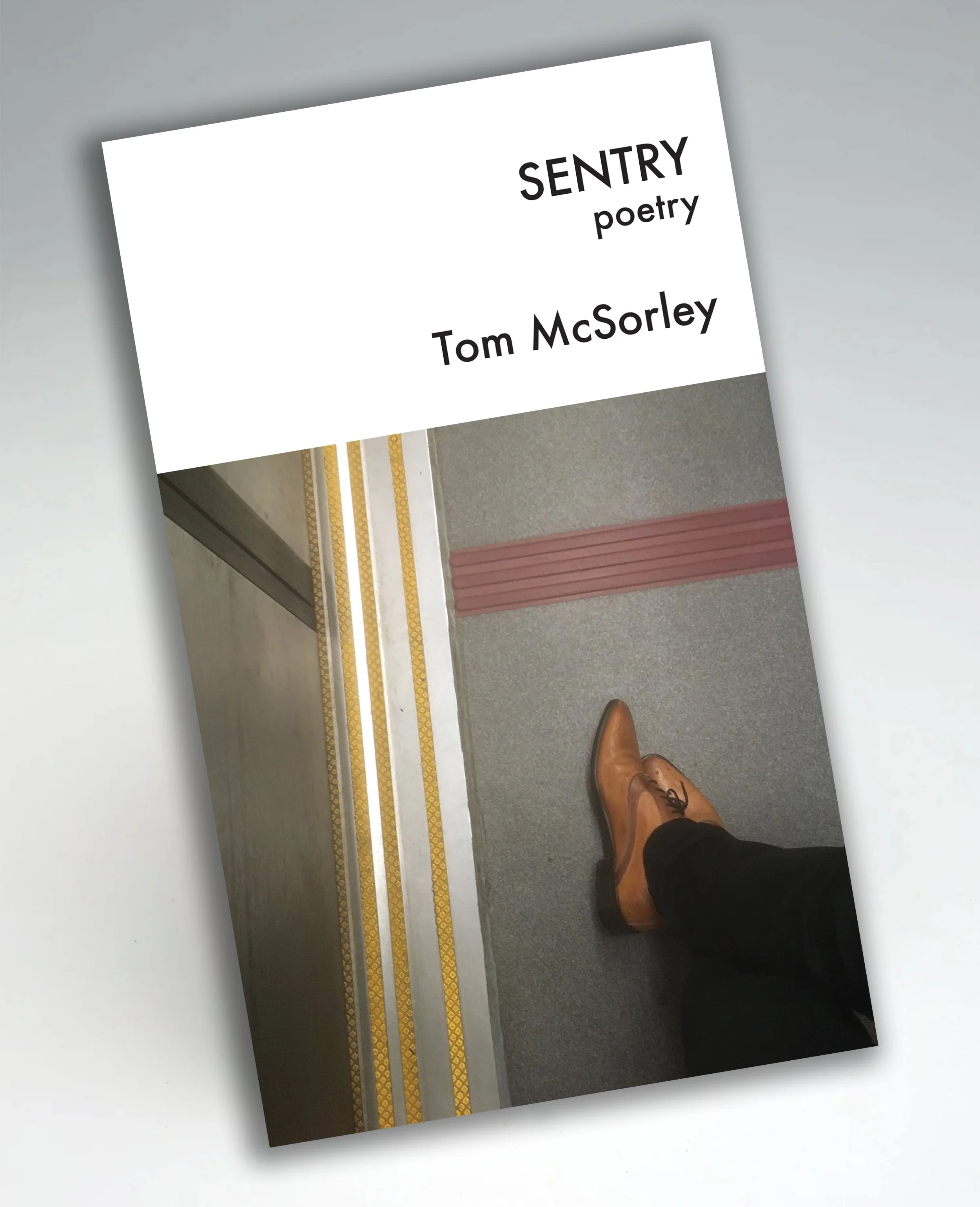
Canadian poet, Tom McSorley, interrogated by US Border Guards (portrayed here by Tina Legari and Hal Hartley) about his latest collection.
Legari: Why Sentry?
McSorley: (skeptical but cooperative) I’ve always liked the sound of the word, and its associative meaning of someone assigned to patrol something; that sense of being dispatched, as it were, to keep an eye on things; to go out on reconnaissance missions. A sentry has no real force or power, but rather fulfills the duties of observation and reportage. I like to think this collection of poems reflects the results of many, many years of my own personal sentry duty.
Hartley: So, this collection includes older work?
McSorley: Yes, it’s a mixture of poems written as far back as the early 1980s and through the intervening four decades. In making the selections, I was struck by how my younger observational voice is not so dissimilar to what is found in my more recent poems. Not sure what that says about me: arrested development, maybe?
Legari: (of photo on book) What’s with the shoes? Are they your feet on this cover, and the other two books?
McSorley: Yes, those are all my feet and my shoes. I’m not sure. Taking pictures of my feet is my version of ‘physical graffiti,’ I guess. I suppose I like to make sure my feet are still under me, and I am still connected to the ground. You know, like, hey, I am still here. This looking down at my feet and shoes really began in earnest, though, after I spent two weeks in Japan in 2001. I grew very fond of the ritual gesture of bowing to other people. It’s so much more attentive a personal interaction than a handshake. You must stop in place, put your feet together, and bow to the person — no rushing by. If nothing else, I hope this relates to poetry being an unhurried form of attention.
Legari: (opens notepad) Shoe size?
McSorley: Nine.
Hartley: What kind of writing utensils do you use?
McSorley: Fountain pens, ball point pens, pencils, whatever is close by.
Legari: (vaguely troubled) You don’t write poetry on a computer word-processor?
McSorley is speechless, afraid he’s hurt the officer’s feelings. Then...
Hartley: (interjects) Where do you write, then?
McSorley: Almost anywhere. I often scribble notes down while in transit: on trains, airplanes, buses. And I am certainly not above the pretentious act of writing at cafés and bars while on the road. The place I love the most to write is on the front balcony of my home.
Legari: (openly suspicious) A sense of environment is central to your poems! Details of space, the activity within that space, the angle of view! If I’m not mistaken, there’s just one reference to a camera as a tool of poetic reference in this collection!
The suspect is again unable to address the officer’s need for an explanation and looks to her associate for help.
Hartley: (sighs, checks his text messages, obliges) Is there anything you do not write about?
McSorley: (out on a limb, bravely) I like to think that everything is available. I’m likely wrong about this, but I never impose limits, at least not consciously, on what I write about.
Legari: (comes closer, friendly, encouraging) Do you doodle in the margins?
McSorley: No. Just words, scratched out words, and arrows pointing at arrangements and re-arrangements of words.
Legari: Any music playing?
McSorley: Almost never. If there is music, it would be Gregorian chant or some lengthy ambient work by Brian Eno. I prefer to write in silence, as I need to listen for the words I’m searching for.
Legari: (of the knitted cap clenched in his hand) Any toque in winter?
McSorley: Yes. A black one. My wife likes how I look in it, plus it makes me feel a kinship with The Edge.
Legari: (satisfied, turns away, consults notes, then—) Who is your favourite female poet?
Now McSorley, in his element, tosses aside his toque, sits back and kicks his feet up onto a nearby end table.
McSorley: Oh, there are so many: Elizabeth Bishop, Lorna Crozier, Dionne Brand, Sor Juana Ines de la Cruz, Patti Smith, PK Page, Maya Angelou, Anne Carson… the list is long. If I have to choose one, it would be the incredible Canadian poet, Margaret Avison.
Hartley: (at bar, studies wine bottle, finds corkscrew) Red or white?
McSorley: Both. I am Canadian.
Hartley: (concedes, opens the red) Okay. How about “To Us in the Sistine Chapel”? The personal, the intimate, in contact with the vast movements of history and, also, seeing this history as perhaps an illusion, ancient public relations, so to speak, which has, for a lot of people, lasted. It’s pointless to paraphrase a poem. If you could have said it differently, you would have. But there are longer lines here, an almost prose flow, a less syncopated rhythm. Are you aware of different music to your thoughts in relation to different subjects?
McSorley: Not exactly, at least it arrives and flows from pen to paper (in that case, a tiny shard of paper I had in my knapsack). It’s more like a rush of thought that, at some level, I am trying to capture and later weave together as poetically and, I suppose, prosaically as I can.
Legari: (paging through book) “Muscle Memory,” page 117. So, you are a real Canadian drummer?
McSorley: I do play drums, but even when not behind the kit I tap, tap, tap away. Yes, this is a stab at trying to comprehend and convey somehow what my incessant finger drumming might mean.
Hartley: (brings their wine) And “A Fact’s a Fact,” page 109. About as straight as it gets regarding creatural reality. This is an interesting one to set alongside “Sistine Chapel.” It makes me reconsider, a little less skeptically, the public relations aspect of human culture. Maybe it’s worthwhile, after all, to astonish the populace with sights and sounds celebrating the longed-for heavens. It might elevate us above the loons and keep us from devouring one another’s children! And reinforce an appreciation of poetry, the mental labor of arranging words just so. Maybe we were made for this.
McSorley: Maybe we were. The ruthlessness of the natural world often impresses and dismays me. Such wonder and beauty; such raw, unrelenting terror. All the anthropomorphism in the universe will not keep those loons from their devouring. I remember what Werner Herzog said about nature, prompted by his experience of shooting Fitzcarraldo in the jungles of Brazil; in that marvelous German-inflected English he states that in the natural world all he sees is “murder and copulation.” Let’s hope our modest human practices elevate us above that condition, at least most of the time.
While Officer Legari steps out into the hall to inform her superiors this particular Canadian poet poses no clear and present danger to the short-term interests of the US economy, McSorley and Hartley stand at the window considering the airport runway stretching out to the horizon far beneath them.
Hartley: Do you, like me, hesitate and gradually succumb to poetry in translation, in a language you’re not conversant with? What about Cavafy, for instance, whom you end this collection invoking?
McSorley: That’s a great way to put it: hesitation followed by surrender; after all, if you don’t speak the original language of the poet, you either learn that language or read the works in translation. Cavafy’s translators are quite good I am told by my Greek friends, and I have no choice but to believe them. The Cavafy I read in English is evocative and moving in English — I can only imagine its magnificent beauty in Greek. After all those years of aesthetic anxiety about the fact that I can’t read Octavio Paz or Antonio Machado or countless other poets in their native languages, I have to come to think that translated poetry is akin to cover versions of songs; the song is there, but due to intrinsic language differences (cadences, rhythms, even sonorities) it will of necessity sound similar but different, as if played in a different key or maybe on different instruments.
Hartley: “Sonnet Attempt #2”. An actual sonnet with rhymes. And a good one. How did it feel to do that and what prompted you?
McSorley: It was a huge challenge, as it is totally contrary to my free form instinctual way of writing. What prompted it was an idea launched during pandemic times. My wife’s family and I would gather on Sunday evenings via Zoom and read Shakespeare’s plays together, each person taking on several roles per play. We also dipped into his Sonnets. Someone then suggested we all take a stab at writing a sonnet ourselves and, when ready, share it with the group. This is what I came up with, and not without some considerable but, I have to admit, really enjoyable labour. To anticipate your next question, having a set poetic structure to work within can sometimes be very challenging but also quite liberating. I wrote this one to honour my parents.
Hartley: Do you entertain or challenge yourself sometimes attempting different and more traditional forms? Besides haiku.
McSorley: I’ve totally embraced attempting traditional poetic forms, as with haiku and the sonnet. Most recently I am writing a series of poems in the Japanese poetic form, tanka. It’s 31 syllables over five lines structured as 5-7-5-7-7. It’s kind of an elaboration on haiku, I suppose, but it presents some thrilling opportunities. Next up, I’m going to try the pantoum, a Malaysian verse form adapted by French poets and occasionally imitated in English. It’s built as a series of quatrains, with the second and fourth lines of each quatrain repeated as the first and third lines of the next. The second and fourth lines of the final stanza repeat the first and third lines of the first stanza. All these formal exercises offer their own possibilities and pleasures, and help with the craft, like strict but understanding instructors.
Hartley: (nods, ignoring his pinging phone, and raises his glass to drink) You’re free to go.
McSorley: (looks away, exhales, and returns his gaze to the airfield, wondering what he did with his toque.)
~
From Sentry, Tom McSorley (2025)
TO US IN THE SISTINE CHAPEL
(for Tina and for my children)
All those myths
of our creation scoured
out of air and terra firma
and earthly pigment
across dour centuries:
such illuminations dimming in
shadows of doubt, lacerations of reason.
Looking up now
it seems so insubstantial,
a helpless human idea
dreaming itself into
being on rough stone
walls and ceilings,
wishing that celestial
finger would touch you,
me, all of us
waiting below;
but knowing as we
filter through these chambers
that such a wish was
designed to be nothing more
than the continuation of
such a wish.
Quietly now we exit,
holding hands together
gently in the gathering
throngs about to disperse
into the piazza, the streets,
and those rivers of time
endless and only ours.
~
Find all of the ways to purchase Sentry here.
PLEASE subscribe to our newsletter! Thanks!